
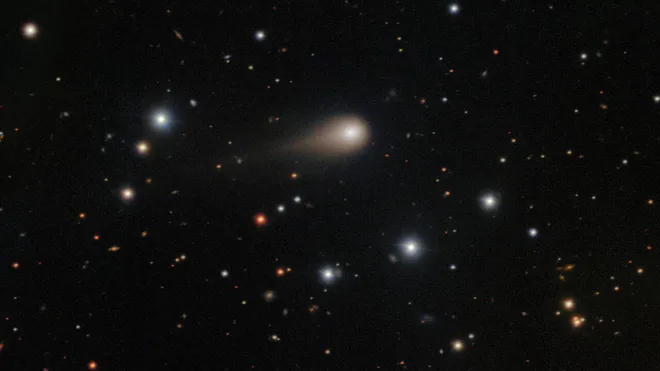
Every so often, our solar system receives a visitor from the depths of interstellar space. These are not ordinary comets like Halley’s or Hale-Bopp. Instead, they are rare cosmic wanderers that formed around other stars and have traveled for millions, even billions, of years before passing near our Sun. The latest guest, Comet 3I-Atlas, has captured the attention of astronomers worldwide — and for good reason.
What Makes Comet 3I-Atlas Special?
Comet 3I-Atlas is only the third interstellar object ever confirmed, following the discovery of ‘Oumuamua in 2017 and Comet 2I/Borisov in 2019. Unlike regular comets, which are native to our solar system, interstellar comets are formed around distant stars. They carry unique chemical signatures and structural clues that help scientists understand how planetary systems form across the galaxy.
The Comet’s Tail Is Growing
Using the Gemini South telescope in Chile, astronomers recently observed Comet 3I-Atlas developing a spectacular growing tail. This glowing streak of dust and gas is formed as the Sun’s heat causes ice and frozen gases within the comet’s core to vaporize.
The comet’s tail isn’t just a visual spectacle. Its chemical composition provides scientists with a direct look at the building blocks of faraway star systems. By studying it, researchers hope to learn whether the conditions that created Earth and our planets are common throughout the galaxy.
Does It Pose a Threat to Earth?
The short answer is no. Comet 3I-Atlas is not on a collision course with our planet. Instead, it will pass safely through the solar system, visible only to advanced telescopes. But even though it poses no danger, it offers a once-in-a-lifetime opportunity for astronomers to analyze material from beyond our cosmic neighborhood.
Why Interstellar Comets Matter
Interstellar comets act like cosmic messengers. They bring with them dust, ices, and organic molecules from places far beyond our reach. Studying them could answer profound questions such as:
Do all planetary systems contain the same basic elements?
Could the building blocks of life be widespread in the universe?
How common are Earth-like conditions around distant stars?
The fact that we’ve already detected three such visitors in just a few years suggests that interstellar comets may be more common than previously thought.
The Bigger Picture
The discovery of 3I-Atlas highlights how much more powerful our modern telescopes have become. Instruments like Gemini South, along with NASA’s James Webb Space Telescope (JWST), are opening new windows into our understanding of the universe. Each new discovery pushes us closer to answering one of humanity’s oldest questions: Are we alone?
Conclusion
While Comet 3I-Atlas may not be visible to the naked eye, its scientific importance cannot be overstated. This icy traveler is not just a visitor — it’s a messenger from another star system, carrying secrets from worlds we may never see. For astronomers, it’s an extraordinary chance to peek into the chemistry of distant suns and perhaps find clues about life’s universal story.
