
The James Webb Space Telescope (JWST) has quickly become one of the most powerful tools in astronomy, offering humanity unprecedented views of the universe. From peering into the atmospheres of distant exoplanets to spotting the earliest galaxies, JWST continues to reshape what we thought we knew about space.
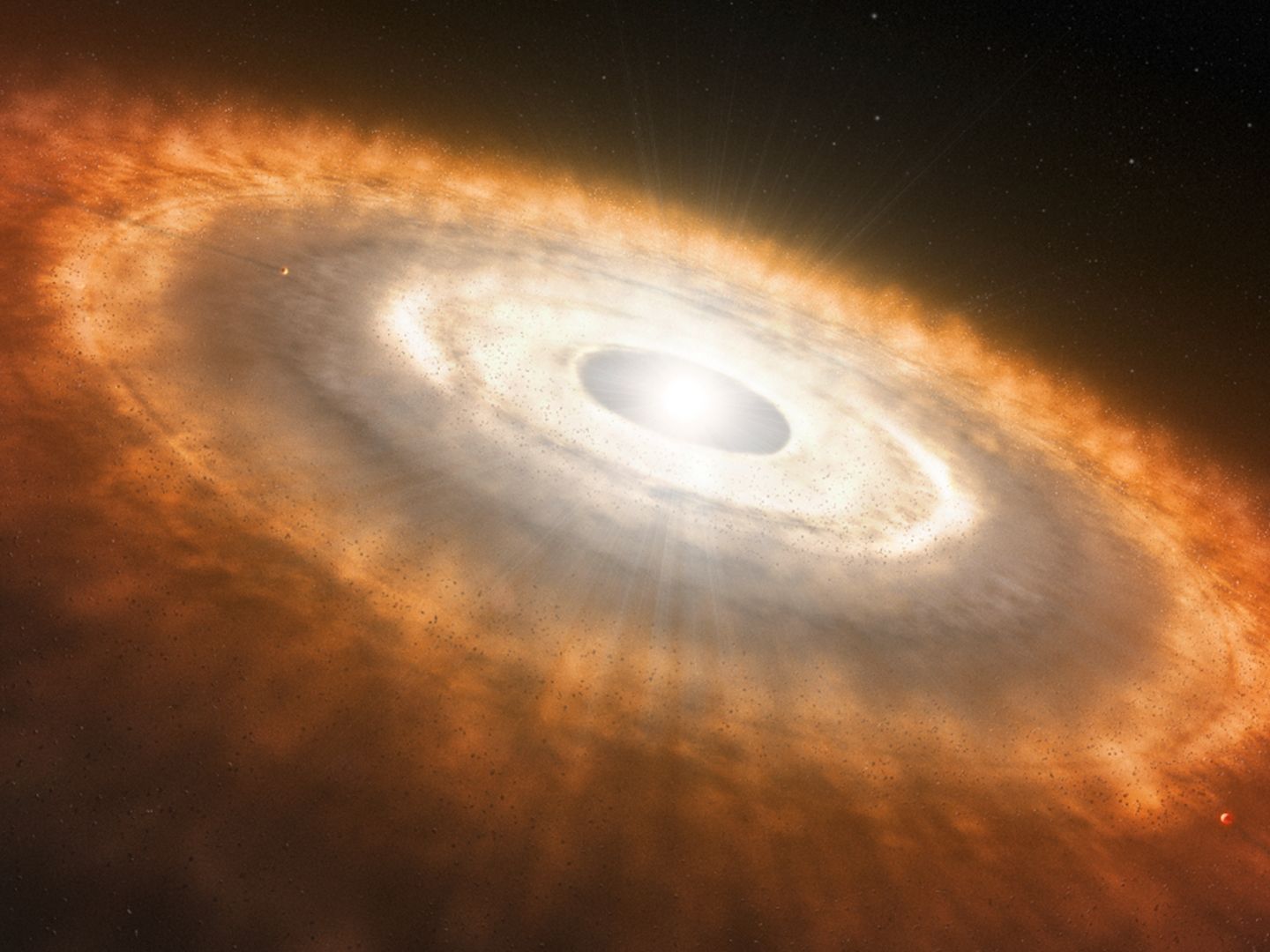
Now, scientists using JWST have discovered something truly puzzling: a planet-forming disk around a young star that lacks water vapor, one of the most essential ingredients for life as we know it. This finding challenges long-standing theories about how planets form and raises new questions about the conditions needed for Earth-like worlds.
What Exactly Did JWST Find?
Astronomers turned JWST’s powerful infrared instruments toward a young star system called XUE 10, located in the NGC 6357 star-forming region. Around this star, they expected to see the typical components of a protoplanetary disk — dust, gas, carbon-based molecules, and, most importantly, water vapor.
To their surprise, while JWST detected carbon dioxide and dust, it found virtually no water vapor. This is strange because water is usually one of the most abundant molecules in planet-forming regions. Without it, the process of forming rocky, habitable planets like Earth might be very different.
Why This Is So Surprising
Current scientific models predict that water should be a major part of these young disks. In fact, many scientists believe that Earth’s oceans originated from icy comets and water-rich planetesimals formed in the solar system’s disk billions of years ago.
Finding a disk without water suggests that:
Not all planetary systems form in the same way.
Water-rich planets like Earth may be rarer than we thought.
Environmental conditions, such as strong UV radiation from nearby stars, might strip water away before planets can form.
Possible Explanations
Researchers are considering several reasons why water might be missing from this particular disk:
Radiation Effects: Powerful ultraviolet light from surrounding stars may have broken apart water molecules.
Unusual Dust Composition: The dust may not trap water ice effectively, leaving the disk drier than normal.
Timing of Observation: It’s possible we are observing the disk at a stage when water vapor is temporarily absent but may appear later in the process.
What This Means for the Search for Life
This discovery has major implications for astrobiology. Water is a cornerstone of life on Earth, so astronomers have long assumed it must also be common in other planetary systems. If some disks form without water, that means not every star system has the potential to host habitable worlds.
On the other hand, this could also mean that the universe has a much greater diversity of planetary types than we ever imagined — some with water, some without, and others with entirely different chemistries.
The Bigger Picture
The finding demonstrates the incredible capabilities of JWST. For the first time, scientists are not just guessing what happens inside these dusty cocoons — they are directly measuring the chemical ingredients of planets as they are being born. Every observation is a piece of the puzzle that tells us how common Earth-like worlds may be across the galaxy.
Conclusion
The discovery of a planet-forming disk with no detectable water vapor is a reminder that the universe rarely follows our expectations. While Earth may feel like the blueprint for habitability, JWST is showing us that nature has many ways of building planets. Some may be familiar, but others may be entirely alien.
As researchers continue to analyze these systems, one thing is clear: our journey to understand the origins of planets and life is just beginning, and the James Webb Space Telescope is leading the way.

